
 See My Latest Article on HelloNation
Young children build language through everyday interactions. Talking, listening, reading, singing, and responding to a child’s attempts to communicate all help develop vocabulary, understanding, pronunciation, and confidence.
For families in Amherst, OH, language learning can happen during ordinary routines at home, outside, in the car, or while preparing for seasonal changes. Children do not need formal lessons to make progress. They need frequent opportunities to hear meaningful language and use it with supportive adults.
How does language development begin?
Language development starts before children use clear words. Babies communicate through eye contact, facial expressions, gestures, sounds, and body movements. Adults support early communication by noticing these signals and responding consistently.
As children grow, language typically develops across several connected areas:
- Understanding words and directions
- Using sounds, gestures, words, and sentences
- Taking turns during interaction
- Learning how conversations work
- Using language to express needs, ideas, emotions, and questions
Development does not happen at exactly the same pace for every child. Some children talk early but understand less complex directions, while others understand a great deal before speaking often. The quality of interaction matters more than comparing one child with another.
What can adults do during everyday routines?
The most useful language practice is woven into activities that already happen each day. Adults can describe what they are doing, name objects, and pause to give children time to respond.
During meals, an adult might say, “The banana is soft,” or ask, “Would you like water or milk?” During dressing, phrases such as “First the shirt, then the sweater” help children connect words with actions and sequence.
Other routines offer similar opportunities:
- Describe steps while washing hands.
- Name colors, shapes, textures, and sizes during play.
- Talk about sounds heard outdoors, such as wind, birds, or vehicles.
- Use simple directions during cleanup.
- Discuss what is happening while walking through the neighborhood or visiting a park.
- Invite children to help sort laundry, utensils, toys, or books.
The goal is not to quiz children constantly. Natural conversation gives them a reason to listen and communicate.
How should adults respond when a child says only a few words?
Adults can expand what a child says without demanding repetition. If a child says “truck,” an adult might respond, “Yes, a big red truck,” or “The truck is going fast.” This provides a slightly more advanced example while keeping the exchange enjoyable.
If a child points to a cup, the adult can say, “You want your cup,” and then offer it. If the child says, “Dog run,” the adult might reply, “The dog is running outside.”
Helpful responses include:
- Repeat the child’s words clearly.
- Add one or two related words.
- Respond to gestures as meaningful communication.
- Avoid correcting every pronunciation mistake.
- Give the child time to finish before answering.
- Show interest through eye contact and facial expression.
Children learn from hearing accurate language many times. Frequent correction can make some children hesitant to speak, especially if they already feel unsure.
Why are shared books useful for language growth?
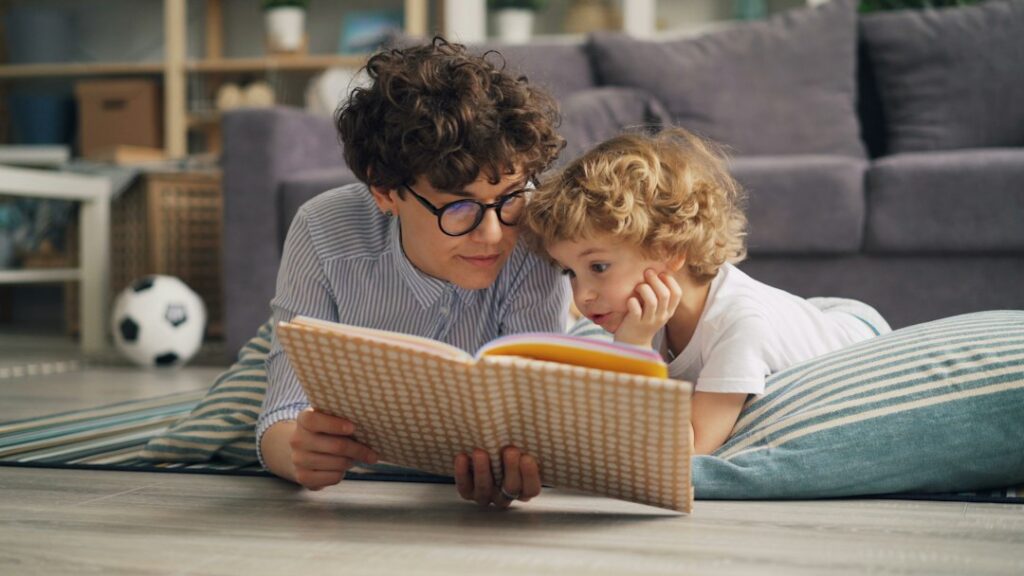
Shared reading supports vocabulary, listening, memory, storytelling, and conversation. Children benefit even when they cannot read the printed words themselves.
Instead of reading every page quickly, pause to discuss the pictures. Ask questions such as:
- “What do you notice?”
- “What might happen next?”
- “How does the character feel?”
- “Where is the ball?”
- “What happened at the beginning?”

For younger children, naming pictures and repeating predictable phrases may be enough. Older preschoolers can retell parts of a story, describe causes and effects, or connect the story to personal experiences.
A child does not need to sit perfectly still to benefit. Looking at a few pages, talking about one picture, or returning to a favorite book can all support development. During colder months or rainy days, regular reading can provide a calm indoor routine without relying on passive screen use.
How do play and pretend activities encourage communication?
Play gives children a reason to use language. In pretend play, children practice vocabulary, conversation, planning, and social problem-solving.
An adult can join without taking control. If a child is pretending to cook, the adult might ask, “What are you making?” or say, “The soup needs a spoon.” If children are building with blocks, an adult can describe the structure, suggest a problem to solve, or encourage them to explain their plan.
Open-ended materials are especially useful because they support many possibilities. Boxes, toy dishes, stuffed animals, blocks, paper, crayons, and natural objects can become part of stories and games. Children often use more language when adults follow their interests rather than directing every step.
How can families support language during outdoor activities?
Outdoor experiences provide rich opportunities to describe movement, weather, nature, and safety. In Amherst, changing seasons can give children new words and observations throughout the year.
Adults might talk about:
- Wet pavement after rain
- Wind moving branches
- Snow, ice, or melting water
- Spring buds and fallen leaves
- Shadows, puddles, and changing light
- Clothing needed for different temperatures
Rather than simply naming objects, invite children to compare and predict: “Which puddle is deeper?” “What do you think will happen when the snow melts?” These conversations build both language and early reasoning skills.
Safety directions also become language lessons when stated clearly and consistently. Short phrases such as “Stop at the edge,” “Hold my hand,” or “Look before crossing” help children connect words with actions.
Do screens affect language development?
Screens do not replace responsive conversation. Young children generally learn language most effectively through back-and-forth interaction with attentive people. A program may introduce words, but children still need opportunities to use those words in real situations.
If screens are part of family life, adults can make the experience more interactive by watching together, discussing what is happening, and connecting the content to play or daily routines. Background television or other constant noise may make it harder for children to notice speech and participate in conversation.
The central question is not only how much content a child sees, but how much meaningful interaction surrounds it.
When might a child need additional support?
Families should discuss concerns with a pediatric health provider or qualified speech-language professional when a child loses communication skills, rarely responds to sounds or speech, is difficult to understand for their age, or does not seem to understand familiar directions. Persistent frustration during communication can also be worth discussing.
A concern does not automatically mean that a child has a disorder. Hearing differences, developmental variation, multilingual language learning, and other factors can affect communication. Early evaluation can clarify what support may be useful.
Families can keep notes about what a child understands, says, gestures, and does in different settings. Specific examples are often more helpful than general descriptions such as “talking late.” Children who speak more than one language should be considered across all languages rather than judged by vocabulary in only one language.
What matters most for language development?
Children benefit from adults who listen closely, respond warmly, and make conversation part of ordinary life. Talking during meals, reading before bed, describing outdoor discoveries, and joining pretend play can create steady opportunities for growth.
Language development is not a race. Consistent interaction, realistic expectations, and attention to a child’s individual communication style provide a strong foundation for learning.